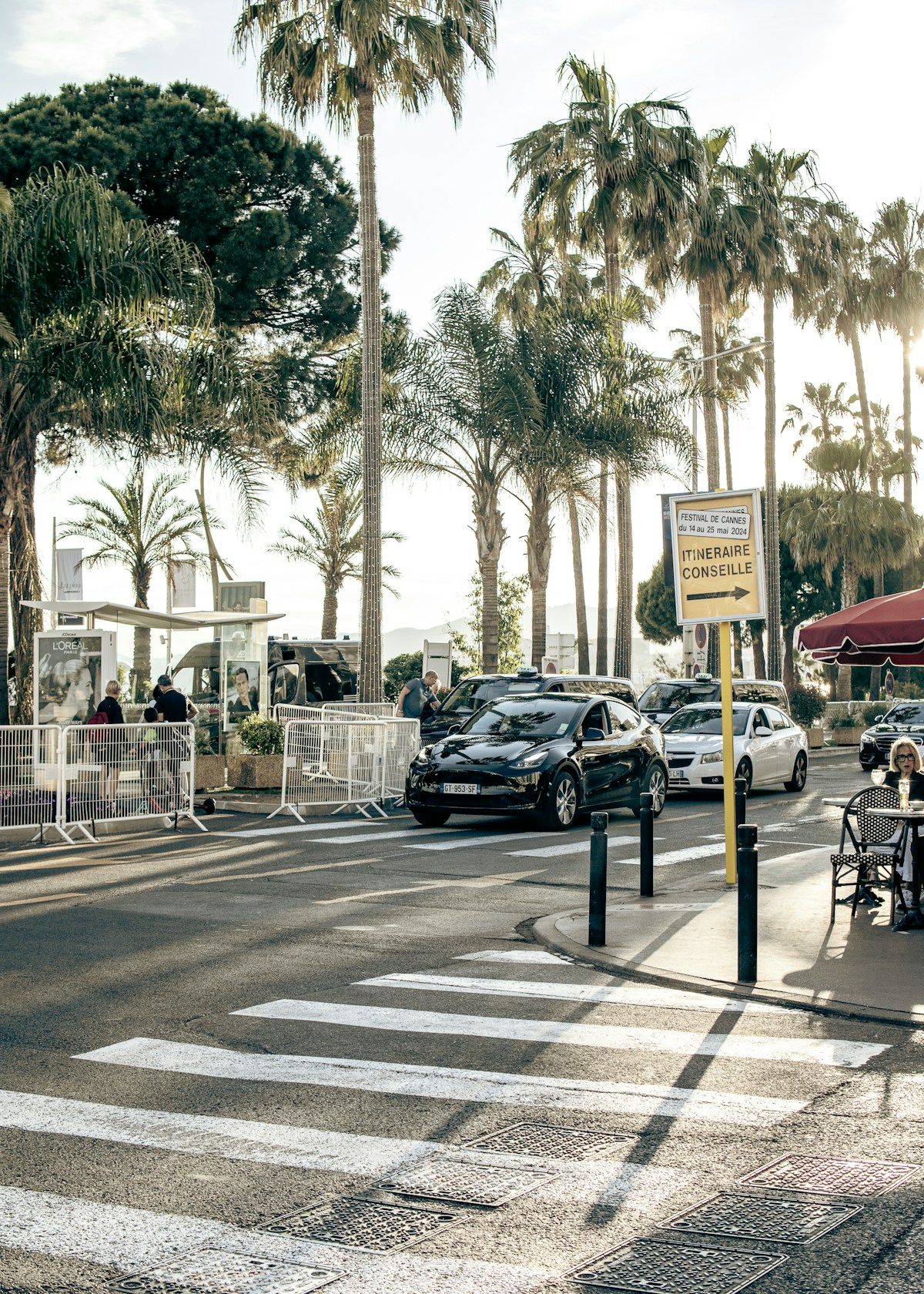
Cannes is first of all a town for walking
Getting around Cannes without a car starts with a simple observation: the tourist heart can be covered entirely on foot. From the SNCF station to the Croisette, it is a walk of about ten minutes down a gentle slope. Rue d'Antibes, the main shopping street, links the station district to the Palais des Festivals in an almost straight line, and the Old Port extends the walk on the sea side.
Walking takes care of most trips in a typical day: breakfast in town, shops, lunch facing the port, an afternoon at the beach. The distances between these points rarely exceed a kilometre. The only real hill is the climb to Le Suquet, the old town perched above. Our pointers for exploring the lanes of Le Suquet help you pace the effort and pick the right moment, rather than the full midday sun.
On foot, you also keep the freedom to change course: a terrace you spotted, a market, a quieter beach. It is the most flexible mode for anyone staying in the centre. It quickly shows its limits once you aim for La Bocca, the convention centre to the west or an early morning train connection with luggage.
The criteria that decide the mode of transport
Before choosing between walking, bus, train or bike, four criteria settle the matter far better than a map. Running through them saves you waiting for a bus to cover three hundred metres, or setting off on foot in 32 degrees.
- The real distance. Under a kilometre, walking almost always wins, waiting time included. Beyond that, the bus or the bike regain the advantage.
- The weather and the time of day. In the heat of a summer afternoon or an autumn shower, the air-conditioned bus beats walking. Early in the morning and in the evening, the opposite is true.
- Luggage and shopping. A suitcase, a beach cooler or market bags change the equation: you then favour the direct trip, with no connection and no hill.
- Budget and length of stay. For a few trips, a single ticket is enough. Over several days, a book of tickets or a short-stay pass works out markedly cheaper.
These criteria combine. Reaching the Lérins Islands with a picnic on an August morning does not follow the same logic as a round trip to the shops in the town centre. The Palm Bus network serves the whole Cannes urban area, which covers almost every scenario once walking is no longer enough.
Walking, bus, train, bike: the comparison
The table below sets the four modes against the criteria that really matter to a visitor. It does not name a single winner: each mode answers a specific type of trip.
| Mode | Ideal for | Range | Watch out for |
|---|---|---|---|
| Walking | Town centre, port, Croisette | Under 1.5 km | The climb to Le Suquet, midday heat |
| Bus (Palm Bus) | La Bocca, districts, distant beaches | The whole urban area | Variable frequency out of season |
| Train (TER) | Antibes, Nice, neighbouring villages | The Côte d'Azur coast | Check timetables the day before |
| Bike | Flat seafront, La Bocca | Medium trips with no hills | Heavy traffic in summer, hills |
Walking and the bus cover the bulk of a city stay. The bus takes over as soon as you leave the very centre: the beaches of La Bocca, the hotels to the west, a late return when your legs are tired. A single ticket can be bought on board or at a sales office, and a short-stay pass quickly pays for itself over several trips.
The TER changes the scale. From Cannes station, it reaches Golfe-Juan, Juan-les-Pins and Antibes in a few minutes, then Nice a little further on. It is the most efficient option for a car-free day trip, far from the seafront traffic jams. The bike, finally, shines on the flat seafront but copes badly with the slopes of Le Suquet and summer traffic.
Reaching the key points without using the car once
Beyond the theory, a few trips come up in almost every stay. Preparing them ahead avoids unpleasant surprises and improvised taxis.
- The station to your accommodation. If you are staying in the centre, walking is almost always enough. Towards La Bocca or the hills, find the most direct bus line before you arrive, suitcase in hand.
- The centre to the beaches. The central beaches can be reached on foot from the Croisette. For the beaches further west, the bus runs along the coast; our selection of accessible beaches in Cannes spells out which ones are worth the walk and which call for a ride.
- The port to the Lérins Islands. Boarding is at Quai Laubeuf, in the Old Port, within walking distance of almost the whole centre. To time the first boat, check our pointers on crossings to the Lérins Islands the day before you leave.
- Cannes to the neighbouring towns. The TER remains unbeatable for Antibes or Nice: no parking to find, no traffic jams on the Basse Corniche.
One case is worth planning for: arriving by car all the same. If you drive to Cannes before leaving the car to rest, it is better to aim for a long-stay car park from day one. Our guide to parking in Cannes without driving in circles shows where to park for several days without coming back to move the vehicle, which makes the rest of the stay entirely pedestrian.
Building your trips around the day
The right habit is not to pick a single mode, but to piece trips together. A successful day in Cannes often mixes all four: walking in the morning for the market and the lanes, the bus in the afternoon to a quieter beach, the train every other day for a nearby escape, the bike in the evening along the sea when the traffic dies down. Each leg is chosen according to the distance, the heat and what you are carrying.
This flexibility is also a way of living the town like a resident rather than a visitor in a hurry. To build a coherent stay area by area, our advice on planning your trip to Cannes helps you group visits by zone and limit pointless back-and-forth. Fewer trips, better timed: that is the whole gain of a town you learn to cross without a steering wheel.
Frequently asked questions
Can you visit Cannes without a car?
Yes, very easily. The centre, the Old Port, the Croisette and Rue d'Antibes are all walkable. The Palm Bus network serves the districts further out, and the TER train links the neighbouring towns. In high season the car even becomes a handicap, between traffic jams and full car parks.
How do you get between Cannes and the beaches without a car?
The central beaches are within walking distance of the Croisette. For the beaches further west, towards La Bocca, the bus runs along the seafront and saves you hunting for a parking space. Cycling is still pleasant on this flat stretch of coast.
Is the train practical for exploring from Cannes?
Yes. From Cannes station, the TER serves Golfe-Juan, Juan-les-Pins, Antibes and then Nice in a few stops. It is the fastest option for a day trip, without the seafront traffic jams or the question of parking on arrival.
Do you need to buy a ticket in advance?
For a few occasional trips, a single ticket is enough and is easy to buy. If you plan several journeys a day over several days, a book of tickets or a short-stay pass works out cheaper. Check the bus timetables out of season, when services are less frequent than in summer.